
RFP Compliance Matrix Template: Track Every Requirement
Download an RFP compliance matrix and learn how to extract, assign, answer, evidence, review, and trace every requirement.

Written by RFP AI Hub Editorial Team
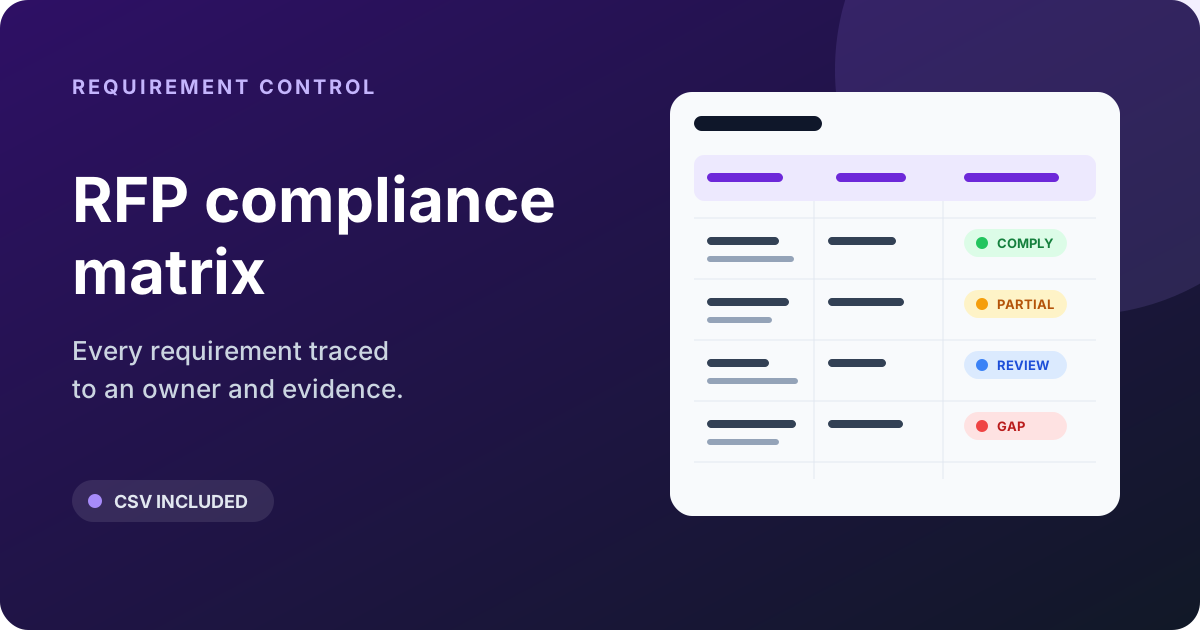
An RFP compliance matrix is a requirement-level map of the entire submission. It tells the team what the buyer asked, where the requirement came from, who owns the answer, whether the offer complies, what evidence supports it, and where the final answer appears.
Download the compliance matrix CSV and use this guide to adapt it to your proposal.

Top alternative for evidence-first teams
Savix
Turn source documents into review-ready RFP answers — with the evidence visible.
Draft in batches, see the excerpt behind each claim, and route exceptions to a human before the response leaves your team.
- $99/mo · 1 user
- $300/mo · 10 users
- Unlimited RFPs
- Unlimited questions
- 14-day trial
Why a compliance matrix matters
RFPs rarely put every instruction in a neat questionnaire. Requirements can appear in the introduction, scope, technical schedules, pricing workbook, contract, appendices, portal instructions, and later addenda.
A matrix prevents five common failures:
- a mandatory item is never assigned;
- a contributor answers the topic but misses the exact requirement;
- two sections make conflicting claims;
- a “yes” answer has no evidence;
- the final response moves, but the team cannot trace it during review.
The matrix is not just a checklist. It is the shared data model for planning, drafting, review, and final production.
The minimum viable matrix
Start with these fields:
| Field | Purpose |
|---|---|
| Requirement ID | Stable identifier for conversation and reporting |
| Source | Document, attachment, portal, or addendum |
| Source location | Page, section, tab, cell, or question number |
| Exact requirement | Verbatim buyer language |
| Normalized requirement | Short action-oriented interpretation |
| Type | Instruction, functional, security, legal, commercial, etc. |
| Mandatory | Identifies knockout or required items |
| Response owner | Person accountable for the answer |
| Reviewer | Person accountable for validation |
| Compliance status | Comply, partial, gap, configurable, or not applicable |
| Response status | Not started, drafting, review, approved, or final |
| Evidence | Source that supports the answer |
| Exception or dependency | Limitation, assumption, or buyer action required |
| Response location | Final section, page, file, sheet, or portal field |
Add complexity only when it supports a decision. For a large technical RFP, useful additions include priority, score weight, product area, requirement relationship, clarification status, word limit, answer expiry, and approval date.
A worked example
| ID | Exact requirement | Owner | Compliance | Evidence | Response location |
|---|---|---|---|---|---|
| SEC-014 | “The solution must support SAML 2.0 SSO.” | Identity lead | Comply | Admin guide §4.2; test tenant | Technical response §6.4 |
| DATA-007 | “Customer must select US, EU, or AU data residency.” | Architecture lead | Partially comply | Architecture brief v3 | Exception EX-02; §6.8 |
| IMP-003 | “Production launch must occur by January 15.” | Delivery lead | Configurable | Draft delivery plan | Implementation §8.1 |
The second row is useful because it does not hide the regional limitation. The third does not promise the deadline in isolation; it connects the answer to a delivery plan and dependencies.
Step 1: inventory every source
Before extracting requirements, list every source of buyer instruction:
- main RFP document;
- statement of work or scope;
- technical and security appendices;
- pricing workbook;
- contract and data-processing terms;
- response forms and declarations;
- portal fields and upload instructions;
- bidder questions and official answers;
- addenda, amendments, and revised files.
Record version, date, and owner. When an addendum arrives, do not silently replace the prior file. Identify which requirements changed, were added, or were withdrawn.
Step 2: extract atomic requirements
One matrix row should represent one testable obligation. Split compound paragraphs when different people, evidence, or statuses could apply.
Compound source text:
The platform must support SAML SSO, automatically provision users through SCIM, and retain audit logs for seven years.
Create three rows:
- support SAML SSO;
- support SCIM provisioning;
- retain specified audit logs for seven years.
If you keep them in one row, the team may mark the entire requirement “Comply” even when only SSO is available.
Retain the exact source language and create a separate normalized field. The original protects traceability; the normalized version makes work easier to assign.
Step 3: classify the requirement
Use types that route work:
- submission instruction;
- functional;
- technical or architecture;
- integration;
- security;
- privacy;
- legal or contractual;
- implementation;
- support and service level;
- pricing or commercial;
- experience and reference;
- accessibility;
- sustainability or social value.
Classification helps spot gaps. If the matrix has 40 security rows but no security reviewer, the staffing problem becomes visible before the deadline.
Step 4: identify mandatory and scored items
Do not assume “must” is the only mandatory signal. Look for:
- must, shall, required, minimum, and mandatory;
- pass/fail or knockout labels;
- minimum score thresholds;
- prescribed forms or declarations;
- submission instructions that can cause rejection;
- contractual terms the buyer will not negotiate.
Record the published score weight when available. Never invent weights. A response team can set an internal priority, but it should be labeled separately from buyer scoring.
Step 5: assign one accountable owner
Each row needs one response owner, even if several people contribute. “Security team” and “Product” are queues, not owners.
Use a separate reviewer field when the answer needs independent approval. Common patterns include:
- product owner writes; solution architect reviews;
- security analyst writes; security leader reviews;
- proposal lead writes; legal counsel approves;
- finance writes pricing; commercial authority approves.
Assign ownership in bulk by type, then inspect exceptions manually.
Step 6: use precise compliance statuses
Define the labels before contributors begin:
| Status | Definition | Required response behavior |
|---|---|---|
| Comply | Requirement is met in the proposed scope | Answer directly and cite evidence |
| Partially comply | Only part is met or a limitation applies | State the boundary and impact |
| Configurable | Met through approved configuration | State work, owner, cost, and timing |
| Third-party | Depends on another product or service | Name responsibility and commercial impact |
| Roadmap | Not currently available | Use only approved roadmap language |
| Does not comply | Not met in the proposed scope | State the gap and viable mitigation |
| Not applicable | Requirement does not apply | Explain why |
| Clarification needed | Buyer intent is ambiguous | Submit a question and avoid guessing |
Keep response status separate:
Not started → Drafting → SME review → Approved → Final
Compliance describes the offer. Response status describes the work.
Step 7: connect claims to evidence
Evidence can include:
- current product or administrator documentation;
- a configured demonstration or test result;
- architecture and data-flow diagrams;
- a current certification or assurance report;
- policy and control documentation approved for sharing;
- contractual commitment;
- implementation plan;
- customer reference with permission;
- approved pricing or scope document.
“Website” is not a useful citation. Record the exact document, page, section, URL, version, and verification date when appropriate.
Distinguish evidence that is public, available under NDA, demonstrable during evaluation, or internal only. Never attach restricted audit material merely because it exists.
Step 8: manage exceptions and dependencies
Give each material exception its own ID and owner. Link it to every affected requirement.
An exception record should contain:
- buyer requirement;
- proposed deviation;
- reason;
- operational and commercial impact;
- mitigation or alternative;
- decision owner;
- approval status;
- final disclosure location.
Dependencies deserve the same discipline. “Six-week implementation” may depend on identity configuration, source-data access, named buyer resources, and acceptance turnaround. Put those conditions beside the promise.
Step 9: trace the final response
The response location should be specific enough for another person to find the answer:
Technical Response §6.4, page 31;Security Workbook, tab Access Control, Q18;Pricing.xlsx, Implementation tab, cell F22;Portal section 3, question 14;Appendix C, Architecture Diagram 2.
Update locations after production changes. A matrix that points to last week's page numbers fails when it is needed most.
Build the first version in 45 minutes
For a moderate RFP, use this focused setup:
Minutes 0–10: source inventory
List documents, attachments, portal sections, deadlines, addenda, and versions.
Minutes 10–25: extract high-risk requirements
Start with submission, mandatory, security, legal, commercial, and deadline-related items. Do not wait for perfect extraction of every narrative preference.
Minutes 25–35: classify and assign
Add type, mandatory status, response owner, reviewer, and clarification flags.
Minutes 35–45: launch control views
Create filtered views for:
- mandatory items;
- clarification needed;
- unassigned requirements;
- gaps and partial compliance;
- overdue drafts;
- missing evidence;
- awaiting approval.
Then continue extraction with the team working from the same structure.
Quality-control checks before submission
Run these checks against the final files:
Coverage
- Every source document and addendum was processed.
- Every mandatory requirement has an answer.
- No row is unassigned or stuck in draft.
- Required forms, signatures, and attachments are complete.
Consistency
- Compliance status matches the narrative.
- Pricing includes the plan, module, service, or third party described.
- Security claims match the security questionnaire and contract.
- Implementation dates match resource and dependency assumptions.
- Repeated requirements receive compatible answers.
Evidence
- Material claims have valid, current support.
- Evidence can be shared at the promised access level.
- Roadmap language and customer references are approved.
- No draft link or inaccessible internal path remains.
Traceability
- Final response locations are correct.
- Exceptions are disclosed consistently.
- The submitted version and matrix are archived together.
Spreadsheet or response platform?
A spreadsheet works when the requirement set is moderate, access is controlled, and one proposal lead can maintain traceability. Dedicated software becomes valuable when teams need document parsing, repeated-question matching, question-level collaboration, governed evidence, automated reminders, version history, or portfolio reporting.
When evaluating RFP response software, test extraction accuracy on your real PDFs, Word files, spreadsheets, and portal exports. Confirm whether the system preserves source location, splits compound requirements, distinguishes generated from approved answers, and exports to the buyer's original format.
For security-heavy responses, compare workflows in the security questionnaire automation guide. For the broader proposal structure, use the section-by-section RFP response template.
Compliance matrix setup checklist
- Download the CSV template.
- Inventory every buyer source and version.
- Split compound text into atomic requirements.
- Preserve exact language and source location.
- Classify mandatory, scored, and informational items.
- Assign one owner and one reviewer where needed.
- Separate compliance status from response status.
- Link material claims to accessible evidence.
- Track exceptions, dependencies, and clarifications explicitly.
- Reconcile the matrix with final files before submission.