
How to Evaluate AI RFP Response Software: 12 Questions Before You Buy
Use a practical 12-question scorecard, scripted pilot, and red-flag checklist to evaluate AI RFP response software for evidence, governance, security, and workflow fit.

Written by RFP AI Hub Editorial Team
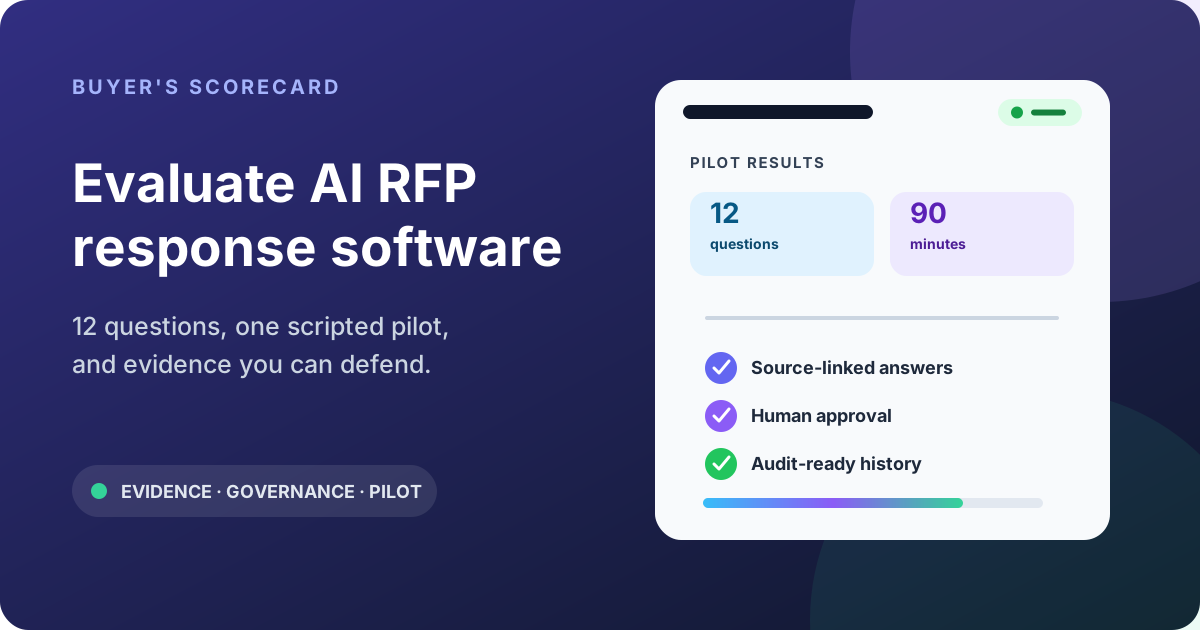
AI RFP response software can help a team find reusable answers, draft a first pass, route questions, and check a response before submission. Those capabilities are useful, but a fluent draft is not the same as a trustworthy answer. A tool can save time and still create risk if it hides the source, reuses an expired claim, exposes restricted material, or turns an assumption into a promise.
The right evaluation therefore starts with the workflow around the model. Can your team see what source informed an answer? Can an owner approve, edit, or reject it? Can the system preserve the difference between “complies,” “partially complies,” and “not applicable”? Can administrators control who can retrieve evidence and what happens to customer data?
This guide provides a 12-question scorecard and a scripted pilot. It is designed for proposal, sales, security, legal, and revenue-operations leaders evaluating AI RFP response software. The NIST AI Risk Management Framework is a useful voluntary reference for governing, mapping, measuring, and managing AI risk. NIST’s AI 600-1 Generative AI Profile describes risks such as confabulation, data privacy, information integrity, human-AI configuration, and value-chain transparency. The current OWASP GenAI LLM Top 10 2026 adds a current security lens for applications powered by large language models.

Top alternative for evidence-first teams
Savix
Turn source documents into review-ready RFP answers — with the evidence visible.
Draft in batches, see the excerpt behind each claim, and route exceptions to a human before the response leaves your team.
- $99/mo · 1 user
- $300/mo · 10 users
- Unlimited RFPs
- Unlimited questions
- 14-day trial
Start with the decision, not the demo
Before speaking with vendors, write down what you are trying to improve. “Use AI for proposals” is too broad to evaluate. A measurable decision might be:
- reduce time spent locating approved answers;
- increase the percentage of requirements with an accountable owner and evidence;
- shorten first-draft time without increasing corrections at final review;
- make security and privacy answers easier to keep current;
- support more opportunities without adding unmanaged access to sensitive content.
Define your baseline for two or three recent opportunities. Record the number of requirements, drafting hours, review hours, late changes, unanswered questions, stale or unsupported claims, and submission defects. Do not assume a vendor’s claimed productivity percentage is comparable to your process. Measure the same task with the same source pack during the pilot.
Also decide which work is in scope. Some teams need RFP requirement extraction and answer drafting. Others need security questionnaire response, content-library governance, or a common workspace for proposal and subject-matter experts. The existing RFP response template and RFP content library guide can help define the process before a platform is selected.
The 12-question scorecard
Score each question from 0 to 2 during a hands-on evaluation:
| Score | Meaning | Evidence required |
|---|---|---|
| 0 | Missing, unclear, or cannot be demonstrated | No reliable evidence or answer depends on a future promise |
| 1 | Partly supported or requires material manual work | Demonstrated with limitations, configuration, or an exception |
| 2 | Clearly supported in the proposed scope | Live demonstration plus written scope, control, or process evidence |
Assign weights before the demos. For a security-sensitive enterprise workflow, evidence lineage, permissions, data handling, and approvals should weigh more than writing style. A high total score should not override a zero on a mandatory control.
1. Can the system show the source behind a suggested answer?
Ask the vendor to retrieve an answer from a controlled source set and show the exact source, version, location, and scope. A citation should point to something a reviewer can inspect, not just display a document title or a confidence number.
Test a question for which two sources conflict. The system should make the conflict visible or route it for review. It should not silently blend old and new language into a more confident paragraph.
Score 2 only when the reviewer can trace a suggestion to an authoritative source and understand why that source was selected. “Our model is trained on your content” is not, by itself, evidence of answer-level traceability.
2. How does retrieval respect scope and permissions?
Ask how the system separates content by customer, product, region, package, audience, and access level. Then test a user who should not see a restricted security report or a customer-specific case study.
The important behavior is not merely whether an administrator can create folders. It is whether search, suggestions, previews, exports, and generated drafts all enforce the same permissions. Ask what happens when a user’s role changes and how access decisions are logged.
3. How are stale answers and changed sources detected?
Proposal content changes. Product behavior, pricing, certifications, subprocessors, regions, and implementation timelines can all become inaccurate while still sounding plausible. Ask the vendor to mark a source as superseded, expire an answer, and compare the result with a previously approved version.
Look for explicit review dates, owner assignment, change history, and a way to block or warn on expired content. A generic “refresh your knowledge base” instruction is not a freshness control.
4. Can the workflow distinguish an answer from a commitment?
Test requirements involving delivery dates, service levels, data residency, integrations, pricing, contractual terms, and roadmap items. The system should preserve qualifiers such as “proposed,” “subject to discovery,” “customer-configured,” or “partially comply.”
Ask whether reviewers can set prohibited claims or required wording. A good workflow makes an exception visible rather than rewriting it into a positive-sounding answer. This matters especially when a generated sentence will later be copied into an executive summary or contract schedule.
5. Are human review and approval states first-class controls?
Ask the vendor to demonstrate the path from generated draft to approved response. You should be able to assign an owner, request an SME review, record a decision, return an answer for changes, and identify who approved the final wording.
Separate “answered” from “approved.” A useful status model might include draft, in review, approved, approved with exception, rejected, and expired. Confirm whether approval applies to a single answer, a section, an evidence asset, or the whole submission, and whether the system preserves the reviewer’s comments.
6. What happens to customer data and prompts?
Request the product’s written data-handling description and contract terms. Ask whether customer content, prompts, outputs, logs, and uploaded files are used to train a shared model; how long they are retained; where they are processed; who can access them; and how deletion requests work.
Do not turn a vendor’s marketing statement into a security conclusion. Confirm the exact product scope and the terms that apply to your plan and region. Your security team should assess the service using its own vendor security questionnaire, evidence requirements, and risk thresholds.
7. Can administrators control source ingestion and change?
Ask who can add, replace, publish, archive, or delete content. Test whether a contributor can upload an unapproved document and immediately make it available to every generated response.
Useful controls include source ownership, approval before publication, version history, effective dates, restricted labels, and an audit record for changes. If the system ingests a shared drive or connector, ask how deleted, moved, duplicated, or conflicting files are handled.
8. Does it support requirements, exceptions, and response locations?
An RFP is not just a document to summarize. The team needs a requirement-level record that connects buyer language to an owner, compliance status, evidence, and final response location. Ask the vendor to extract a compound requirement into atomic items and preserve page, section, table, or question references.
Then test a partial compliance answer. Can the team record the gap, dependency, mitigation, approver, and location of the exception? Can it check that the same requirement is not marked “yes” in one section and “partial” in another?
Use the RFP compliance matrix template as a neutral test schema. The platform does not need to copy that file exactly, but it should support the decisions the matrix enables.
9. Can it preserve a complete change and approval history?
Ask to view the history for one answer before and after an edit. You should be able to see the previous text, new text, editor, timestamp, reason or comment, evidence changes, and approval state.
Test a late source update. If a product owner changes a fact after drafting begins, can the proposal lead identify affected answers? If not, the tool may improve first drafts while making final reconciliation harder. History is also essential for debriefs: teams need to distinguish a model suggestion, an SME edit, and an approved commitment.
10. Does the output fit your real submission workflow?
Use a redacted RFP with its attachments, tables, forms, and formatting constraints. Test export to the formats and portal process your team actually uses. Check headings, requirement IDs, tables, tracked changes, links, page counts, file names, and accessibility.
Ask what happens to content the system cannot safely format or interpret. A clear “needs manual review” status is preferable to an export that looks complete but drops a table, attachment, or qualification. Also test whether the final submitted version can be archived with its source set and approval record.
11. Do integrations improve control rather than only convenience?
List the systems that hold authoritative information: CRM, content library, document storage, identity provider, ticketing, pricing, and security evidence. For each integration, define what data moves in which direction, which system is authoritative, how often it syncs, and what happens when a record changes.
Ask to demonstrate revoking a connector, changing a user’s role, and handling a failed sync. An integration that copies data into a second uncontrolled repository may increase duplication and exposure. Evaluate the control boundary, not the number of logos on a feature page.
12. Can you measure quality and operational impact?
Agree on metrics before the pilot. Useful measures include time to first complete draft, percentage of requirements with source-linked evidence, reviewer correction rate, stale-answer rate, unresolved exceptions, approval cycle time, and final production defects.
Ask whether the system can export or report these measures by opportunity, team, source, reviewer, and time period. Treat model confidence as a prompt for review, not as a quality metric on its own. The strongest result is not “the AI wrote more words”; it is a faster controlled process with equal or better accuracy.
Run a scripted pilot
A scripted pilot makes vendors comparable. Give each one the same redacted or synthetic test pack:
- one representative RFP with instructions, addenda, tables, and a pricing workbook;
- a small approved content set with owners, versions, and effective dates;
- one superseded document and one deliberately conflicting source;
- two restricted evidence files that a standard contributor must not retrieve;
- four test requirements: one direct match, one compound requirement, one partial-compliance case, and one unsupported question;
- a short reviewer brief describing the required approval path.
Keep the pack free of confidential customer and security information unless your approved assessment process permits it. The pilot should test product behavior, not reward a vendor for receiving your most sensitive data.
Suggested 90-minute pilot script
Minutes 0–10: intake. Ask the vendor to identify sources, versions, requirements, deadlines, and missing information. Record what was extracted automatically and what required manual setup.
Minutes 10–30: retrieval and drafting. Run the same four requirements. Require the operator to open the source behind each suggestion, inspect its scope, and explain any uncertainty.
Minutes 30–45: governance test. Publish a source, supersede it, change an answer owner, and attempt retrieval as a restricted user. Record warnings, blocked actions, and audit events.
Minutes 45–60: exception and review test. Mark one requirement partially compliant, assign an exception owner, request SME review, edit the answer, and approve it. Verify that the status and history remain visible.
Minutes 60–75: change-impact test. Replace one approved source with a new version. Ask the vendor to identify affected drafts or answers and show how the prior approval is represented.
Minutes 75–90: export and measurement. Export the response package, inspect formatting and traceability, and capture the metrics defined before the pilot. Ask what the system could not demonstrate.
Use the same operators, timebox, source pack, and scoring rules for every vendor. Have proposal and security reviewers score independently before discussing the result. Keep a short evidence log with screenshots or exported records, but do not accept screenshots as a substitute for written product scope or contractual terms.
Red flags that should stop or narrow the evaluation
- The demo uses only polished sample questions and avoids a conflicting or unsupported requirement.
- The vendor cannot show the source, version, scope, or retrieval reason behind a generated answer.
- “Human in the loop” means a user can edit text, but there is no owner, approval state, or audit history.
- Expired or superseded content remains searchable without a warning or policy control.
- The system presents roadmap, configurable, or partial compliance as a simple “yes.”
- Permissions apply to folders but not to search, previews, generated output, or exports.
- Data-use answers are verbal, generic, or limited to a model name rather than the proposed service and contract.
- The pilot requires uploading sensitive customer evidence before basic controls can be assessed.
- Reported time savings are not measured against the same source pack and review standard.
- A connector creates a second source of truth without ownership, sync rules, or deletion behavior.
- The vendor dismisses a request for written scope, retention, access, or incident information as “not relevant to the AI feature.”
These are not proof that a product cannot work. They are reasons to pause, narrow the use case, request evidence, or set a non-negotiable condition before procurement proceeds.
Make the decision with a weighted scorecard
After the pilot, calculate a weighted score but keep mandatory gates separate. For example, use a 1–5 importance weight for each question, multiply it by the 0–2 evidence score, and record the source supporting the score. Then add a decision column:
| Decision | Meaning |
|---|---|
| Proceed | Meets mandatory controls and demonstrates measurable workflow value |
| Proceed with conditions | Useful fit, but named gaps have owners, evidence, and dates before production |
| Pilot only | Safe for a restricted use case while the team gathers more evidence |
| Do not proceed | A mandatory control is missing or the workflow risk is not acceptable |
Write the decision in operational language. “Best AI” is not a decision record. “Proceed with conditions: proposal-only workspace, no restricted security evidence, mandatory SME approval, and quarterly source review” is testable and can be revisited.
FAQ
Is the best AI RFP tool the one with the most fluent writing?
No. Writing quality matters, but it is one part of a controlled response process. Source traceability, permissions, approvals, exception handling, output fit, and measurable correction rates are usually more important for a high-risk proposal.
Should we upload our full content library during a demo?
Use a redacted or synthetic pack for the initial comparison. Share production material only after your security, privacy, legal, and procurement owners approve the assessment terms and scope.
Is a citation enough to prove that an answer is accurate?
No. A citation helps a reviewer inspect the source. Accuracy still depends on the source’s scope, date, applicability, and interpretation, as well as human review for the buyer’s requirement.
How much human review is necessary?
That depends on risk and materiality. Require accountable review for commitments, security and privacy claims, pricing, exceptions, roadmap statements, and any answer with weak or conflicting evidence. Lower-risk formatting or retrieval work may need lighter review.
Should AI-generated answers be saved to the content library automatically?
No. Treat them as drafts until an owner verifies the wording, scope, evidence, and restrictions. Automatic publication can turn one mistaken answer into a reusable error.
What should the contract cover?
At minimum, align the contract and security review with the actual service: customer-content use, model training, retention and deletion, subprocessors, processing locations, access, incident handling, availability, export, and support. The exact requirements depend on your risk assessment.
Can one platform handle RFPs and security questionnaires?
Sometimes, but test the separate control needs. An RFP workflow emphasizes requirements, evaluation factors, deadlines, and production. A security questionnaire workflow emphasizes evidence scope, restricted access, control ownership, and expiry. A shared platform is useful only if it preserves those differences.
The goal is not to buy the most impressive AI demo. It is to choose a workflow your team can explain, measure, review, and defend when an answer matters.