
RFI vs RFP vs RFQ vs DDQ: What Changes in the Response Workflow?
Learn the practical differences between RFI, RFP, RFQ, and DDQ responses, then map each request to the right intake, evidence, review, and automation workflow.

Written by RFP AI Hub Editorial Team
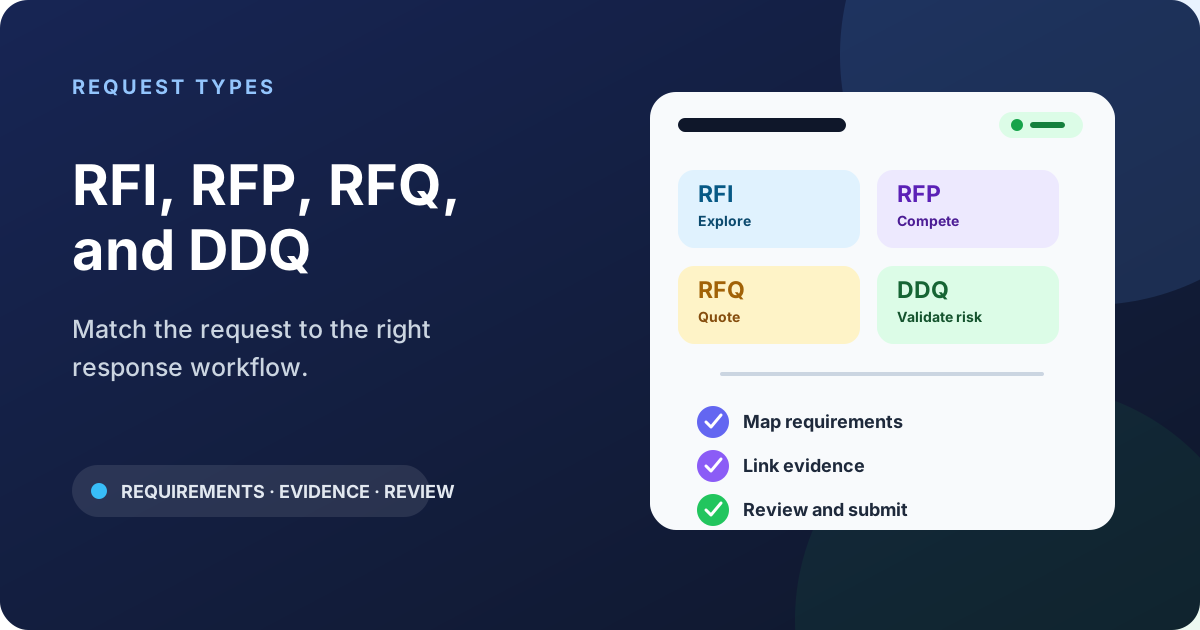
RFI, RFP, RFQ, and DDQ are often treated as interchangeable requests for information. They are not. Each one asks the supplier to help the buyer make a different decision, so the response needs a different workflow, evidence standard, and approval path.
The distinction matters when a team is trying to automate proposal work. An RFI response may educate a buyer about capabilities before a formal solicitation exists. An RFP response must follow instructions and compete against evaluation criteria. An RFQ response is usually organized around a defined requirement and a quotation. A DDQ response helps a buyer assess operational, security, privacy, or financial risk before they approve a vendor.
This article gives a practical taxonomy and a workflow you can use across all four. In formal U.S. federal procurement, the Federal Acquisition Regulation (FAR) describes RFIs and exchanges with industry, RFPs, and the legal effect of quotations. Commercial usage varies by buyer, country, and industry, so the buyer's own instructions remain the source of truth.

Top alternative for evidence-first teams
Savix
Turn source documents into review-ready RFP answers — with the evidence visible.
Draft in batches, see the excerpt behind each claim, and route exceptions to a human before the response leaves your team.
- $99/mo · 1 user
- $300/mo · 10 users
- Unlimited RFPs
- Unlimited questions
- 14-day trial
The short answer
| Request | Buyer is usually trying to learn or decide | Supplier response | Primary workflow | Typical automation priority |
|---|---|---|---|---|
| RFI — request for information | What the market can provide and how a future requirement might be shaped | Capabilities, approaches, indicative information, and clarifying context | Discover and educate | Extract questions, reuse approved capability facts, flag confidential information |
| RFP — request for proposals | Which offer best meets stated requirements, terms, and evaluation criteria | A scored proposal with compliance, solution, commercial, and delivery detail | Compete and commit | Build a compliance matrix, assign requirements, ground answers in evidence, control versions |
| RFQ — request for quotation | What a defined purchase will cost and under which conditions | A quotation responding to specified scope, quantities, pricing, and terms | Price and fulfill | Normalize line items, calculate pricing, validate assumptions, generate quote package |
| DDQ — due diligence questionnaire | Whether a supplier presents an acceptable business, security, privacy, or financial risk | Structured answers, evidence, exceptions, and ownership | Validate and approve risk | Map questions to current evidence, enforce review, track expiry, preserve audit trail |
The labels do not determine the workflow by themselves. A buyer can call a spreadsheet an “RFP” while asking for a lightweight market survey, or call a security assessment a “DDQ” while requiring a formal contract exception. Read the instructions, identify the decision being made, and classify the request accordingly.
RFI: shape the conversation before the competition
An RFI is generally a discovery instrument. FAR 15.201 says an agency may use an RFI when it does not presently intend to award a contract but wants price, delivery, market, or capability information for planning. It also says there is no required RFI format and that responses are information rather than offers.
For a supplier, that changes the goal. You are not trying to submit a complete proposal against a final scoring model. You are helping the buyer understand what is feasible, where the market has options, and which requirements may need refinement.
RFI response workflow
- Confirm the purpose. Record whether the buyer wants capability information, market research, indicative pricing, implementation ideas, or feedback on a draft requirement.
- Separate facts from suggestions. Product capabilities and delivery constraints should come from approved sources. Recommendations about a future requirement should be clearly labeled as recommendations.
- Answer at the right altitude. Explain relevant approaches and trade-offs without producing a full solution design that the buyer did not request.
- Protect confidential information. Mark material according to the buyer's instructions and your own disclosure policy. Do not include customer names, security details, or pricing assumptions merely because they appeared in a prior response.
- Capture learning. Save the buyer's terminology, likely requirements, and unanswered questions as structured opportunity intelligence. Do not treat the RFI as a commitment to bid.
The useful automation unit for an RFI is the approved capability fact, not a generated paragraph. A search-and-reuse system can help a contributor find the correct product description, integration boundary, or implementation pattern. A reviewer should still decide whether the fact is relevant to the buyer's exploratory question.
RFP: answer a scored, governed solicitation
An RFP is more than a long questionnaire. Under FAR 15.203, an RFP communicates the government's requirements and solicits proposals; a competitive RFP describes the requirement, anticipated contract terms, information required in the proposal, and evaluation factors and their relative importance.
That structure creates a stricter response obligation. The team must answer the question asked, follow the submission instructions, disclose exceptions, and make it easy for evaluators to find the evidence they will score. A polished narrative is not complete if a mandatory form is missing or if two sections promise incompatible delivery dates.
RFP response workflow
- Freeze the source set. Inventory the main RFP, attachments, appendices, pricing workbooks, contract terms, portal fields, official Q&A, and addenda. Record versions and dates.
- Extract atomic requirements. Split compound instructions so each row can have one owner, status, evidence set, and response location.
- Build the compliance baseline. Mark mandatory items, page or word limits, file requirements, signatures, exceptions, and buyer evaluation factors.
- Qualify the opportunity. Use a documented RFP go/no-go decision before assigning a large team to drafting.
- Draft with evidence. Use a controlled RFP content library, but adapt every reusable answer to the buyer's requirement and scope.
- Review in gates. Run compliance, solution, commercial and risk, buyer-perspective, and production checks. The proposal review process can provide the gate structure.
- Submit and preserve the record. Store the exact submitted files, confirmation, time zone, and any post-submission clarification.
Automation is most valuable where it improves traceability: requirement extraction, owner routing, answer retrieval, evidence links, stale-content alerts, and version history. It should not silently turn “partially comply” into “yes,” or infer a contractual promise from a generic product sentence.
RFQ: make a defined purchase comparable
An RFQ normally starts with a more defined purchase than an RFI. In a federal schedule context, FAR 8.405-3 says an RFQ for services includes a statement of work and evaluation criteria. FAR 13.004 also explains that a quotation is not an offer that the government can simply accept to form a binding contract; the legal mechanics depend on the applicable purchasing procedure.
Commercial buyers use RFQ differently, so do not assume that “quotation” means price-only. The request may include quantities, delivery locations, service levels, implementation assumptions, optional items, taxes, validity periods, and terms that affect the total offer.
RFQ response workflow
- Normalize the requested basket. Convert line items, quantities, units, options, and requested dates into a structured pricing model.
- Validate scope. Check that the quote covers the exact product, package, region, users, environments, services, and support level requested.
- Expose assumptions. State dependencies such as customer-supplied data, travel, integration work, minimum quantities, lead times, and taxes.
- Route approvals. Pricing, legal terms, delivery dates, discounts, and non-standard commitments may require different approvers.
- Reconcile the package. Confirm that the quote, cover letter, implementation description, and contract exceptions use the same quantities, currency, dates, and commercial terms.
The right automation is calculation and consistency control. A response platform should help prevent a quantity mismatch between a pricing workbook and a PDF quote, but the commercial owner remains accountable for the approved price and terms. Link the RFQ to the opportunity and preserve the effective date of the pricing model.
DDQ: turn risk questions into an evidence decision
DDQ is a broad business term rather than one universal solicitation format. In practice, a due diligence questionnaire may cover information security, privacy, resilience, financial health, insurance, legal entity information, sanctions, modern slavery, sustainability, or operational controls. The sender may be a procurement, security, privacy, legal, finance, or third-party risk team.
Security questionnaires are often standardized to make vendor reviews more comparable. Shared Assessments describes SIG as a standardized information-gathering questionnaire for vendors and other third parties. That is useful context, but a SIG- or DDQ-style question still needs an answer scoped to the service under review. A corporate policy or certificate may not cover every product, region, environment, subprocessor, or contract period.
DDQ response workflow
- Define assessment scope. Identify the service, data types, access model, processing locations, criticality, customer entity, and requested review period.
- Classify the questions. Separate policy, control, architecture, privacy, resilience, financial, legal, and commercial questions. Route each class to an accountable owner.
- Match answers to evidence. Store the source, version, effective date, scope, access restriction, and expiry for every evidence item.
- Use controlled answer states. “Draft,” “in review,” “approved,” “approved with exception,” and “expired” are more useful than a single completion percentage.
- Make limitations visible. If a control is partly available, customer-configured, product-specific, or not applicable, explain why and identify the decision owner.
- Export and retain. Preserve the final questionnaire, evidence package, exceptions, approvals, and submission timestamp.
The automation unit for a DDQ is the answer-and-evidence relationship. A useful system can suggest a prior answer, but it should also show why the suggestion applies, which source supports it, when the source was approved, and what changed since the last review. This is different from a generic vendor security questionnaire template, which helps a buyer decide what to ask.
One intake model for all four request types
Teams do not need four disconnected systems. They need one intake record with a request-type-specific workflow. Start with these shared fields:
| Shared field | Why it matters |
|---|---|
| Request type and buyer | Determines the workflow and terminology |
| Source files, links, versions, and addenda | Establishes the authoritative baseline |
| Buyer decision and deadline | Defines what “complete” means and when it matters |
| Scope: product, service, region, entity, and data | Prevents answers from being reused outside their boundary |
| Requirements or question IDs | Creates stable references for owners and reviewers |
| Owner, reviewer, and approver | Makes accountability explicit |
| Evidence and response location | Supports traceability from source to final answer |
| Status, exception, and next action | Turns the record into an operating queue |
Then add type-specific fields:
- RFI: market question, capability theme, draft requirement feedback, disclosure level.
- RFP: evaluation factor, mandatory status, page limit, compliance status, response location.
- RFQ: item, quantity, unit, currency, validity, delivery date, discount, and commercial approval.
- DDQ: risk domain, control scope, evidence expiry, restricted-access flag, exception owner, and remediation date.
This shared model also makes reporting more honest. “Completed” can mean an RFI answer was submitted, an RFP requirement was approved, an RFQ line was commercially reconciled, or a DDQ question has current evidence. Do not compare those percentages without defining the underlying status.
A practical classification test
When a request arrives, ask these five questions:
- Is the buyer exploring the market or selecting a supplier now?
- Is the response expected to be a proposal, a quotation, or information for planning?
- Are evaluation criteria, required forms, or contract terms specified?
- Is the buyer testing risk and evidence rather than solution fit or price?
- What would make the response unacceptable: missing information, non-compliance, price, risk, or an unsupported commitment?
The answers determine the first workflow. If the request mixes types, split it into workstreams rather than forcing every question into one label. For example, an RFP can contain an RFQ pricing workbook and a DDQ security appendix. Track those components separately, then reconcile them before submission.
FAQ
Is an RFI the same as an RFP?
No. An RFI generally helps a buyer understand the market or refine a future requirement. An RFP normally asks suppliers to submit proposals that will be evaluated against stated requirements and factors. Some organizations use the labels loosely, so follow the actual instructions.
Is an RFQ always just a price request?
No. Price may be central, but scope, quantities, delivery, options, service levels, and terms can all affect the quotation. Extract the complete requested basket before calculating a price.
Is DDQ a formal standard like RFP?
Not universally. DDQ usually describes the purpose of the review—due diligence—rather than one mandatory format. Security teams may use standards such as SIG, while a buyer may create a custom questionnaire for its own risk model.
Can AI automatically answer all four request types?
AI can assist with extraction, retrieval, classification, drafting, and consistency checks. It should not independently approve a contractual promise, security control, price, or exception. Require an accountable reviewer and retain the source and approval history.
What should we automate first?
Start with repetitive, observable work: file and question inventory, requirement IDs, routing, approved-answer retrieval, evidence links, stale-content alerts, and version comparison. Automate judgment only after the team has defined the decision rule and an owner who can approve the result.
How should we link this workflow to a response template?
Use the request type to choose the starting template, then map every retained section or answer to a requirement. The RFP response template is a useful starting point for proposal structure, but an RFI, RFQ, or DDQ may need a smaller or more specialized package.
The durable principle is simple: classify the buyer's decision first, then automate the evidence and controls that make that decision easier to trust.