
Proposal Review Process: A Red Team RFP Checklist
Build a proposal review process with compliance, solution, commercial, red team, and production gates plus a downloadable RFP review checklist.

Written by RFP AI Hub Editorial Team
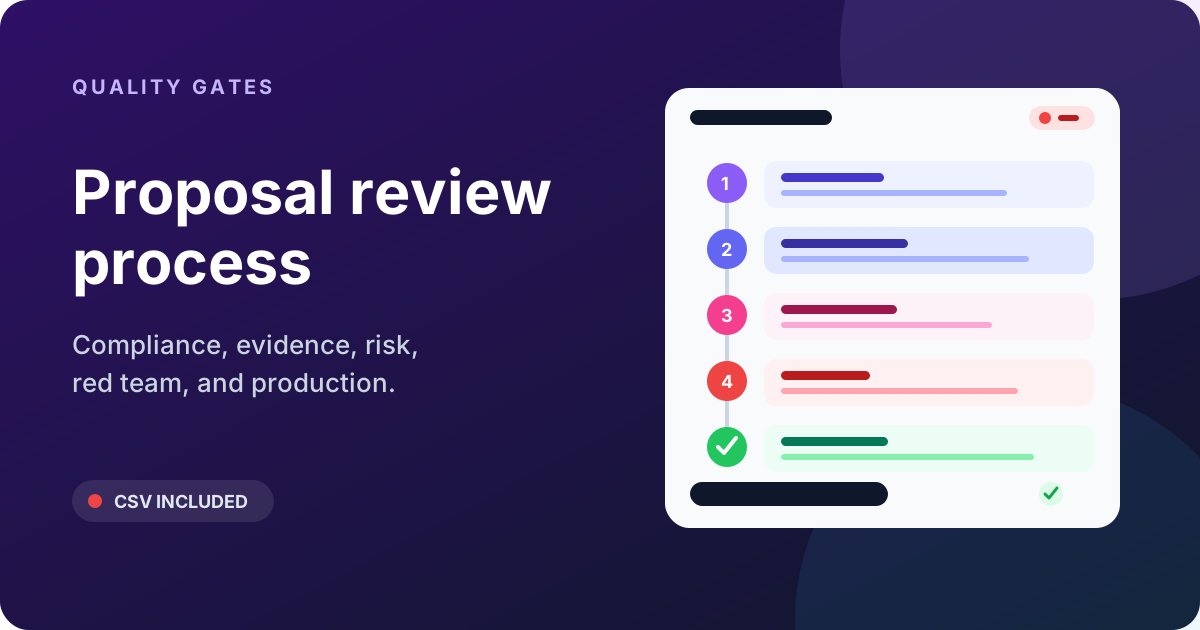
A proposal review process should answer more than “Did someone read the document?” It should verify that the response is compliant, accurate, persuasive, commercially sound, consistent, and ready to submit.
The most reliable process uses focused review gates with different owners and acceptance criteria. Asking one executive to review the entire proposal the night before the deadline creates comments, not control.
Download the proposal review checklist CSV. It includes review gates, checks, evidence, owners, findings, severity, actions, due dates, and approval status.

Top alternative for evidence-first teams
Savix
Turn source documents into review-ready RFP answers — with the evidence visible.
Draft in batches, see the excerpt behind each claim, and route exceptions to a human before the response leaves your team.
- $99/mo · 1 user
- $300/mo · 10 users
- Unlimited RFPs
- Unlimited questions
- 14-day trial
The five-gate proposal review process
Use these gates for a high-value or complex RFP:
| Gate | Primary question | Typical owner |
|---|---|---|
| 1. Compliance | Does the submission follow every instruction and answer every requirement? | Proposal lead |
| 2. Solution and evidence | Is the proposed answer accurate, feasible, and supported? | Solution lead and SMEs |
| 3. Commercial and risk | Do scope, price, terms, security, and delivery assumptions agree? | Commercial, legal, security, delivery |
| 4. Red team | Will an evaluator understand, believe, and score the response well? | Independent senior reviewer |
| 5. Production | Are the exact files and portal submission complete and usable? | Proposal production owner |
Small proposals can combine gates, but the questions should remain separate. A persuasive response can still be non-compliant; a compliant response can still make an unapproved promise.
Schedule reviews backward from submission
Start with the buyer deadline, time zone, portal, and upload requirements. Then create internal gates with recovery time.
An illustrative ten-business-day schedule:
| Timing | Milestone |
|---|---|
| Day 1 | Intake, qualification, source inventory, and compliance matrix |
| Day 2 | Response plan, owners, win strategy, and clarification questions |
| Day 5 | First complete draft—not necessarily polished |
| Day 6 | Compliance and solution reviews |
| Day 7 | Commercial, legal, security, and delivery review |
| Day 8 | Red team review and resolution meeting |
| Day 9 | Final approval, production, link and accessibility checks |
| Day 10 | Planned early upload, confirmation, and archive |
This is an example, not a universal duration. Compress or expand it based on complexity, but preserve time between review and submission. A review scheduled after the last safe editing window is ceremonial.
Track the buyer deadline separately from the planned upload time. The planned upload should leave enough buffer to recover from file, portal, account, signature, or connectivity problems.
Before review: define the baseline
Reviewers need a stable package and a clear assignment. Before a gate begins, provide:
- the RFP, attachments, addenda, Q&A, and portal instructions;
- the current compliance matrix;
- the evaluation criteria and known weights;
- the approved win strategy and differentiators;
- the exact response version under review;
- pricing, implementation, exception, and evidence schedules;
- the review scope, deadline, and acceptance criteria;
- a single place to log findings and decisions.
Do not ask reviewers to choose between several “latest” files. Freeze a review version, collect findings, resolve them, and then create the next controlled version.
Gate 1: compliance review
The compliance review tests whether the buyer can accept and evaluate the response.
Submission instructions
Verify:
- due date, time, and time zone;
- portal, email, or physical submission method;
- file types, filenames, size limits, and folder structure;
- page, word, and character limits;
- required order, numbering, headings, and forms;
- signatures, attestations, notarization, or original documents;
- rules for links, attachments, pricing, and alternative offers;
- addenda acknowledgment and required declarations.
Requirement coverage
Check that every mandatory and scored requirement has:
- an accountable owner;
- an explicit response or permitted reference;
- an accurate compliance status;
- supporting evidence where needed;
- an approved exception or dependency;
- a correct final response location.
Search for blank cells, placeholder text, unresolved comments, missing attachments, and answers that respond to the general topic but not the exact question.
Acceptance rule
The gate passes when every instruction and mandatory requirement is either complete or has a named blocking action, owner, and decision deadline. “Mostly complete” is not a useful status two days before submission.
Gate 2: solution and evidence review
Subject-matter reviewers confirm that the proposed solution is truthful, feasible, and properly evidenced.
Accuracy
Validate features, integrations, architecture, data flows, regions, certifications, service levels, implementation activities, roles, dates, and customer examples. Confirm that the answer describes the proposed package—not another product tier or a possible future state.
Completeness
Break compound requirements into their parts. A question about authentication, authorization, logging, and review requires evidence across four control activities.
Evidence quality
For each material claim, ask:
- Is the source current and authoritative?
- Does the evidence support the exact scope of the claim?
- Can it be shared with this evaluator?
- Is it cited or located precisely enough to find?
- Does the response distinguish current capability, configuration, custom work, and roadmap?
Feasibility
Delivery owners should confirm that staffing, sequence, buyer dependencies, acceptance, migration, integration, and support assumptions are realistic. Product support is not the same as an implemented buyer solution.
Use the RFP response examples to calibrate direct, evidenced answers and the RFP content library guide to control reusable source material.
Gate 3: commercial and risk review
Many proposal failures occur between sections rather than inside a single answer. This gate reconciles the offer across disciplines.
Scope and pricing
Confirm that pricing includes every capability, service, environment, integration, user, volume, training item, and support level promised in the narrative. Check totals, units, term, billing, taxes, travel, overages, optional items, validity, and renewal assumptions.
Legal and contractual risk
Review exceptions to terms, liability, indemnity, insurance, intellectual property, termination, warranties, service credits, data protection, governing law, and order of precedence. Ensure narrative promises do not create obligations outside the proposed contract.
Security and privacy
Reconcile the main response, security questionnaire, privacy exhibits, trust material, architecture, subprocessors, hosting, incident language, AI data use, and evidence-access commitments.
Delivery risk
Check dates, resources, subcontractors, buyer responsibilities, dependencies, acceptance criteria, and transition obligations against the delivery team's approved plan.
Exception consistency
Every material gap should have the same status, impact, mitigation, owner, and commercial treatment wherever it appears. A partial-compliance answer must not become “fully compliant” in the executive summary.
Gate 4: red team review
A red team review evaluates the proposal from the buyer's perspective. The reviewer should be independent enough to challenge the response and senior enough to distinguish a scoring problem from a stylistic preference.
What the red team should score
Use a 1–5 scale with written reasons:
| Dimension | Review question |
|---|---|
| Responsiveness | Does the proposal answer what the buyer actually asked? |
| Buyer understanding | Does it reflect the buyer's outcomes, constraints, users, and decision context? |
| Win strategy | Are the reasons to choose the offer relevant, distinct, and evidenced? |
| Credibility | Are claims specific, consistent, and supportable? |
| Evaluator usability | Can a reviewer find, understand, and score the important information quickly? |
| Delivery confidence | Are the plan, roles, dependencies, and risk controls convincing? |
| Commercial clarity | Can the buyer understand scope, total price, assumptions, and trade-offs? |
Scores help expose disagreement; they are not a substitute for findings. A “3” should identify what prevents the response from becoming a “4.”
Questions a red team should ask
- Can I explain the proposed outcome and approach after reading the executive summary once?
- Does each major section lead with a conclusion or make me search for it?
- Are differentiators connected to scored buyer priorities?
- Does every differentiator have proof?
- Are important trade-offs disclosed in proportion?
- Do examples match the buyer's scale, industry, or constraints?
- Is the response specific without inventing buyer facts?
- Are tables, headings, diagrams, and callouts helping evaluation?
- Which three objections would a skeptical evaluator raise?
- If a competitor removed the company name, how much of this proposal could they reuse?
What the red team should not do
The review should not rewrite every sentence into the reviewer's preferred style, reopen settled scope without evidence, or introduce unsupported claims to make the proposal sound stronger. Findings should connect to compliance, scoring, credibility, clarity, or risk.
Classify findings by severity
Use a stable severity model so the team resolves the right problems first.
| Severity | Meaning | Example |
|---|---|---|
| Blocker | Submission cannot proceed safely or compliantly | Missing mandatory form or unapproved material exception |
| Major | Likely scoring, accuracy, commercial, or delivery impact | Unsupported differentiator or pricing/scope conflict |
| Moderate | Meaningful clarity or evidence weakness | Vague implementation responsibility |
| Minor | Local production or wording improvement | Inconsistent capitalization with no scoring effect |
Every finding should include the location, issue, reason it matters, recommended action, owner, due date, and resolution status. “Needs work” is not actionable.
Run a resolution meeting, not a second review
After the red team, hold a short meeting focused on contested and high-severity findings.
For each blocker or major finding:
- confirm the exact issue and evidence;
- decide whether to accept, modify, or reject the recommendation;
- assign one owner and due date;
- identify related sections that also need changes;
- name the approver who will close the finding.
Record rejected recommendations with a concise rationale. Do not leave parallel comment threads unresolved across Word, email, chat, and spreadsheets.
Gate 5: production review
Production review tests the exact submission files—not the source document before export.
Document checks
- correct buyer, RFP title, reference number, and bidder legal name;
- required order, section numbers, page limits, and forms;
- table of contents, bookmarks, page references, headers, and footers;
- readable tables, diagrams, fonts, and page breaks;
- working permitted links and correct attachment references;
- alternative text and accessibility requirements;
- no comments, tracked changes, hidden text, placeholders, or internal metadata;
- consistent filenames and version labels.
Commercial and attachment checks
- final approved pricing files and totals;
- signed forms and authorized signatories;
- current certificates and permitted evidence;
- correct references, resumes, terms, and appendices;
- no internal-only or customer-restricted material.
Portal checks
- correct account and permissions;
- every response field and upload location complete;
- file type and size accepted;
- no portal conversion damage;
- final preview checked where available;
- submission confirmation captured and archived.
Upload before the deadline whenever the process permits. Do not make the buyer's cutoff your internal production milestone.
Define approval authority
Use an approval map so reviewers know what they can close.
| Decision | Typical approver |
|---|---|
| Requirement coverage and production | Proposal lead |
| Product and technical claim | Product or solution owner |
| Security and privacy claim | Security/privacy owner |
| Implementation commitment | Delivery owner |
| Price and discount | Commercial or finance owner |
| Contract exception | Authorized legal/business owner |
| Customer reference and result | Account/customer marketing plus disclosure owner |
| Final submission | Opportunity executive or designated signatory |
Approval should be visible and attributable. Silence after a review deadline is not approval unless an explicit governance rule says so—and high-risk claims should not use silent approval.
Adapt review depth to risk
Not every response needs a full red team and executive gate. Use a risk-based model.
Light review
Suitable for a short, low-risk, highly standardized response. Use compliance, accountable SME validation, and production checks.
Standard review
Suitable for most competitive RFPs. Add commercial/risk reconciliation and an independent buyer-perspective review.
Enhanced review
Suitable for strategic, regulated, novel, high-value, or high-risk offers. Add formal red team scoring, executive review, specialized security/legal gates, reference validation, and a documented resolution meeting.
The RFP go/no-go scorecard can determine review depth, budget, and executive involvement before drafting begins.
Metrics for improving proposal reviews
Track measures that reveal whether reviews prevent failures and improve decisions:
- first-complete-draft delivered on time;
- findings by gate, subject, and severity;
- blocker and major findings discovered after their intended gate;
- time from finding to resolution;
- reopened findings;
- late material changes after final approval;
- internal upload target met;
- buyer clarification caused by avoidable ambiguity;
- evaluation feedback tied to reviewed sections;
- estimated versus actual review hours.
Do not reward reviewers for generating more comments. A mature process should reduce repeated findings by fixing sources, templates, ownership, and upstream decisions.
Common proposal review failures
Reviewing fragments instead of a complete draft
Section reviews are useful, but they cannot reveal contradictions across narrative, pricing, security, implementation, and contract. Set a real first-complete-draft gate.
Inviting too many unscoped reviewers
More reviewers can create contradictory edits and delayed decisions. Assign scope and authority: technical accuracy, commercial risk, evaluator perspective, or production.
Starting red team review too late
Buyer-perspective findings often require structural changes. Leave time to resolve them without breaking compliance or production.
Treating style as strategy
Shorter sentences and active voice help, but they do not replace buyer understanding, differentiated proof, or a feasible offer.
Losing findings across tools
Maintain one finding log with owners, due dates, decisions, and closure. Comments in the draft can point to the log but should not become the only audit trail.
Skipping review after late changes
A revised price, date, exception, diagram, or attachment can affect several sections. Define which changes trigger targeted re-review and final approval.
Final proposal review checklist
- Review gates, owners, dates, and acceptance criteria are scheduled.
- Reviewers have the RFP, addenda, evaluation criteria, and stable response version.
- Every instruction and mandatory requirement is traced.
- Technical, product, and customer claims have accountable approval.
- Scope, pricing, implementation, support, and contract language agree.
- Security and privacy statements match the evidence and questionnaire.
- Material assumptions and exceptions are consistent and visible.
- Red team findings connect to buyer scoring, credibility, clarity, or risk.
- Blocker and major findings have documented resolution.
- The exact exported files pass production and accessibility checks.
- Portal fields, uploads, and final preview are complete.
- Submission confirmation and the exact submitted package are archived.
Download the review checklist and adapt the gates to opportunity risk. Pair it with the complete RFP response template and RFP tracker so deadlines, owners, findings, and approvals remain connected.
Frequently asked questions
What is a red team review in proposals?
It is an independent review from the evaluator's perspective. The red team tests responsiveness, buyer understanding, win strategy, evidence, clarity, delivery confidence, and commercial coherence rather than only proofreading.
When should a proposal red team review happen?
Run it after a complete, internally validated draft exists and early enough to make structural changes. For a ten-business-day response, an illustrative target is two business days before final production, but complexity should determine the actual schedule.
Who should conduct the red team review?
Choose a reviewer or small team independent from the main drafting effort, familiar with proposal evaluation, and authorized to challenge strategy and evidence. Avoid assigning only contributors who are reviewing their own work.
Is proofreading part of proposal review?
Yes, but it is only one part. Proofreading addresses language and consistency; the full process also covers compliance, solution accuracy, evidence, commercial and legal risk, buyer-perspective scoring, production, and submission.