
RFP Go/No-Go Decision Template: Score Every Bid
Download a weighted RFP go/no-go scorecard and learn how to evaluate fit, win probability, effort, risk, and strategic value before you bid.

Written by RFP AI Hub Editorial Team
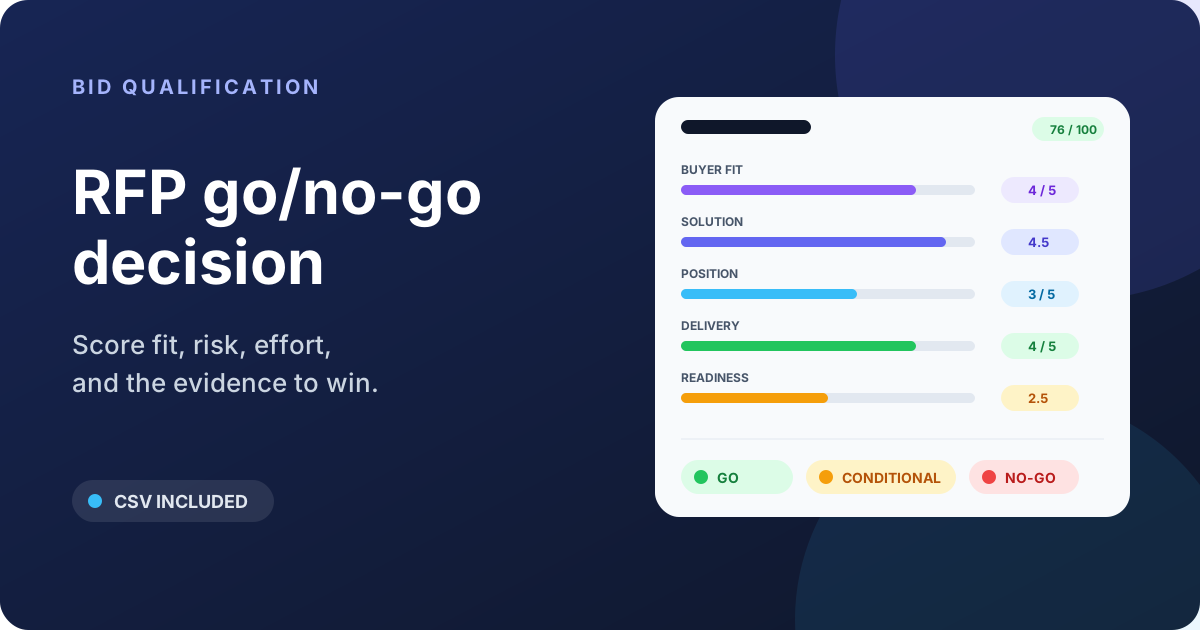
An RFP go/no-go decision is a deliberate choice to bid, decline, or proceed only if named conditions are resolved. The goal is not to reject difficult opportunities automatically. It is to invest proposal, solution, security, legal, and executive time where the team has a credible path to winning and delivering.
Download the RFP go/no-go decision CSV. It includes a 100-point weighted scorecard, knockout checks, owners, evidence, conditions, and a documented final decision.

Top alternative for evidence-first teams
Savix
Turn source documents into review-ready RFP answers — with the evidence visible.
Draft in batches, see the excerpt behind each claim, and route exceptions to a human before the response leaves your team.
- $99/mo · 1 user
- $300/mo · 10 users
- Unlimited RFPs
- Unlimited questions
- 14-day trial
The short version: a defensible decision flow
Use the same sequence for every material opportunity:
- Check hard gates. Identify mandatory conditions that cannot be traded against a high score elsewhere.
- Separate facts from assumptions. Record what the team knows, what it believes, and what it still needs to confirm.
- Score seven dimensions. Use evidence and named owners, not a room-wide show of hands.
- Estimate response cost. Include specialist and approval time, not only proposal-team hours.
- Choose Go, Conditional Go, No-Go, or Defer. Document the reason, owner, and review date.
- Revisit the decision when facts change. Addenda, buyer answers, staffing, competitive information, or new risks can invalidate the first assessment.
A numeric score informs the discussion; it does not replace accountable judgment. A high score cannot override an impossible requirement, and a low score should not be overridden without a specific strategic reason and added controls.
What the template includes
The downloadable scorecard uses seven weighted dimensions:
| Dimension | Weight | Decision question |
|---|---|---|
| Buyer and relationship | 15% | Do we understand the buying context and have useful access? |
| Problem and solution fit | 20% | Can the proposed solution meet the important outcomes and requirements? |
| Competitive position | 15% | Is there a credible, evidenced reason for the buyer to choose us? |
| Delivery feasibility | 15% | Can we implement the proposed scope, timing, and service model? |
| Commercial value | 15% | Is the opportunity economically sound after cost, terms, and risk? |
| Response readiness | 10% | Can the team produce a compliant, approved response by the deadline? |
| Strategic value | 10% | Does the opportunity create value beyond immediate contract economics? |
| Total | 100% |
These weights are a practical starting point. A public-sector bidder may increase compliance and contract risk. A services firm with scarce delivery capacity may increase delivery feasibility. Change the model deliberately, document the reason, and keep it stable long enough to learn from outcomes.
Step 1: define knockout conditions
Knockouts are conditions that can make a bid unacceptable regardless of its weighted score. They should be approved before a favored opportunity appears.
Typical knockout checks include:
- a mandatory certification, license, insurance level, or legal status the team cannot meet;
- a required capability with no acceptable alternative;
- a submission deadline that leaves no viable approval path;
- prohibited contract exposure that the authorized owner will not accept;
- an implementation date the delivery team cannot support;
- a conflict of interest or procurement restriction;
- economics below an approved floor with no strategic exception;
- evidence that the process is closed, predetermined, or materially unfair;
- missing approval to disclose required customer, security, or financial information.
Phrase each knockout so the team can test it. “Bad fit” is too vague. “The RFP requires an active authorization that must be included at submission, and we do not hold it” is a decision-ready fact.
A knockout can be unresolved rather than triggered. In that case, use Defer or Conditional Go with a clarification owner and deadline instead of pretending the issue does not exist.
Step 2: score each dimension from 0 to 5
Use a common scale:
| Score | Meaning | Evidence standard |
|---|---|---|
| 0 | Disqualifying or fundamentally misaligned | Confirmed fact |
| 1 | Major weakness with no credible mitigation yet | Mostly confirmed |
| 2 | Below target; material gaps or uncertainty | Mixed evidence |
| 3 | Acceptable; manageable conditions remain | Sufficient evidence |
| 4 | Strong; clear fit and manageable risk | Good evidence |
| 5 | Exceptional; demonstrated advantage | Direct, current evidence |
Calculate weighted points with:
Weighted points = (score ÷ 5) × weight
For example, a delivery-feasibility score of 4 with a 15% weight contributes 12 points. The CSV includes this formula for every row.
Do not score an unknown as neutral by default. A lack of buyer access or an unreviewed contract is risk, not evidence of average fit. Record the unknown, choose a conservative score, and name the action that could change it.
The seven go/no-go dimensions
1. Buyer and relationship
Ask:
- Do we understand why the buyer is acting now?
- Have we spoken with stakeholders beyond the procurement contact, where permitted?
- Do we know the decision process, evaluation criteria, budget status, and timeline?
- Is there a credible sponsor or internal advocate?
- Did we help shape the opportunity, or are we encountering it for the first time?
Access is not the same as friendliness. A useful relationship produces decision context, honest feedback, and a way to validate assumptions without violating procurement rules.
2. Problem and solution fit
Ask:
- Does the proposed solution address the buyer's priority outcomes?
- Which mandatory requirements are fully met, partially met, configurable, or unmet?
- Are integrations, security, data, service, and implementation needs within the proposed scope?
- Can the team show the important workflows rather than merely claim support?
- Are gaps understood and approved by the relevant owners?
Use the RFP compliance matrix template to test fit at requirement level. A broad “great product fit” score is unreliable when a single mandatory item can disqualify the response.
3. Competitive position
Ask:
- Is there a buyer-relevant reason to choose our approach?
- Can we prove that difference through evidence, a demonstration, a reference, or contract language?
- Is an incumbent advantaged by switching cost, relationships, or requirements?
- Do the evaluation weights reward our strengths?
- Can the team explain how it wins in two sentences without attacking competitors?
“Our people and platform” is not a win strategy. A useful strategy identifies the buyer priority, the meaningful difference, and the evidence that makes the difference credible.
4. Delivery feasibility
Ask:
- Can the delivery team meet the required schedule with realistic dependencies?
- Are the required skills, locations, languages, clearances, and partners available?
- Is the implementation approach proven for comparable scope?
- Can the team support the promised service levels and transition?
- Are buyer responsibilities and third-party dependencies explicit?
Do not let an attractive contract value conceal a delivery plan the operating team has not reviewed.
5. Commercial value
Ask:
- Is the expected contract value large enough relative to acquisition and delivery cost?
- Do pricing expectations fit the target margin and approved discount range?
- Are payment, liability, termination, service-credit, and insurance terms acceptable?
- Is the scope sufficiently clear to price without excessive contingency?
- What is the likely value after probability, response cost, and delivery risk are considered?
If the team uses an expected-value calculation, keep it transparent:
Bid-adjusted value = (estimated contract contribution × win probability)
                     − estimated pursuit cost
This is a decision aid, not a forecast. Win probability and contribution assumptions should have an owner and a documented basis.
6. Response readiness
Ask:
- Is there enough time for intake, clarification, drafting, reviews, approvals, production, and upload?
- Are proposal, solution, security, legal, finance, and executive owners available?
- How much approved content and evidence can be reused safely?
- Are required forms, signatures, references, and attachments obtainable?
- Does the submission portal or format introduce additional work or risk?
Estimate hours by role. A “40-hour response” may consume only 20 proposal hours but also require scarce legal, security, executive, and technical time.
7. Strategic value
Ask:
- Does this opportunity open a priority market, relationship, capability, or reference?
- Is the buyer or use case strategically relevant enough to justify lower short-term economics?
- Will the work create reusable knowledge or evidence?
- Does it align with product and delivery direction?
- Is the strategic value specific, owned, and measurable?
“Logo value” should not become a universal override. State what will become possible, who owns that outcome, and how the team will know whether the bet paid off.
Suggested decision bands
Use score bands as a starting policy, then calibrate them with your own outcomes.
| Total score | Suggested decision | Required action |
|---|---|---|
| 75–100 | Go | Approve pursuit plan, budget, owners, and first review gate |
| 60–74 | Conditional Go | Resolve named conditions by a fixed date; otherwise stop |
| Below 60 | No-Go | Record the primary reasons and communicate the decline |
| Any unresolved knockout | Defer | Assign clarification and set a decision deadline |
| Any triggered knockout | No-Go or executive exception | Obtain authorized, documented exception before work continues |
These thresholds are not benchmarks. If nearly every opportunity scores 80, the scoring definitions are too generous or qualification happens too late. If the model rejects known good fits, revisit weights and evidence standards rather than quietly ignoring the score.
Run a 30-minute go/no-go meeting
Before the meeting
The opportunity owner prepares the RFP, addenda, buyer context, estimated value, timeline, known competition, initial compliance findings, delivery concerns, and contract exceptions. Dimension owners submit preliminary scores with evidence.
Minutes 0–5: confirm the decision and deadline
State exactly what is being approved: exploratory work, a full response, a consortium bid, or a conditional pursuit. Confirm when the decision must be final to preserve a compliant response plan.
Minutes 5–10: review knockouts
Resolve each hard gate as Clear, Triggered, or Unknown. Do not spend 20 minutes discussing strengths before disclosing that a mandatory condition is unmet.
Minutes 10–20: discuss scoring differences
Focus on dimensions where owners differ by two or more points. The disagreement usually reveals missing evidence, different assumptions, or a risk that has not been assigned.
Minutes 20–25: test effort and opportunity cost
Confirm the estimated hours by role and identify which other commitments would move. Capacity is a portfolio question: a reasonable bid can still be the wrong choice during two stronger pursuits.
Minutes 25–30: decide and assign
Record the final decision, rationale, score, conditions, owners, due dates, and next review. If a senior leader overrides the model, record both the original assessment and the approved reason.
Worked example
Consider a fictional software RFP with a good use-case fit but limited buyer access and an aggressive schedule.
| Dimension | Weight | Score | Weighted points | Evidence or concern |
|---|---|---|---|---|
| Buyer and relationship | 15 | 2 | 6 | Procurement-only contact; no discovery completed |
| Problem and solution fit | 20 | 4 | 16 | Core workflow fits; one integration requires validation |
| Competitive position | 15 | 3 | 9 | Relevant difference, but demo proof not yet tested |
| Delivery feasibility | 15 | 4 | 12 | Delivery team confirms scope subject to buyer resources |
| Commercial value | 15 | 4 | 12 | Within target range; contract not yet reviewed |
| Response readiness | 10 | 2 | 4 | Two key reviewers unavailable during final week |
| Strategic value | 10 | 3 | 6 | Relevant sector, but no approved reference plan |
| Total | 100 | 65 | Conditional Go |
The score does not say “bid and hope.” It identifies the conditions: obtain the missing integration detail, secure replacement reviewers, and complete initial contract review by the internal cutoff. If those actions fail, the decision changes to No-Go before full drafting cost is incurred.
Four decision outcomes
Go
The team has a credible win path, no unresolved knockout, acceptable risk, committed owners, and approved pursuit cost. A Go decision launches the RFP response template, compliance matrix, schedule, and review plan.
Conditional Go
The opportunity is attractive only if explicit conditions are met. Each condition needs an owner, evidence requirement, due date, and consequence. “Proceed while we learn more” is not a controlled decision.
No-Go
Declining preserves capacity and can protect the buyer relationship when the fit is weak. Record concise reason codes such as mandatory gap, no access, poor economics, delivery conflict, deadline, contract risk, or no differentiated position. Where appropriate, communicate early and professionally.
Defer
Critical information is missing, but the response window allows clarification before committing. Defer only until a named decision date. Otherwise it becomes an unrecorded Go while contributors begin work.
How to handle overrides
Overrides are legitimate when the scorecard cannot capture an important strategic judgment. They become dangerous when they erase the original risk.
For every override, record:
- the calculated score and triggered or unresolved gates;
- who authorized the override;
- the specific strategic rationale;
- extra budget, staffing, review, or contractual controls;
- the condition that would stop the pursuit;
- a post-outcome review date.
Do not change the underlying scores to make an override look ordinary. Preserving the assessment makes later calibration possible.
Connect qualification to the response workflow
A Go decision should create operational outputs immediately:
- decision rationale and approved win strategy;
- requirement-level compliance matrix;
- response budget and calendar;
- proposal, solution, commercial, legal, security, and delivery owners;
- buyer clarification questions;
- material assumptions and exceptions;
- evidence plan and demonstration plan;
- internal stop or requalification gates.
Track these in the RFP tracker template so qualification does not disappear after the kickoff. Revisit the decision after material addenda, scope changes, failed clarification, new contract language, loss of a key resource, or evidence that changes competitive position.
Improve the model with outcome data
Review the scorecard quarterly or after a meaningful set of decisions. Compare initial scores with:
- bid rate and reason for No-Go;
- win rate by score band;
- shortlist or finalist rate;
- planned versus actual response hours;
- planned versus actual contract contribution;
- delivery exceptions discovered after award;
- conditions that were not resolved on time;
- overridden decisions and their outcomes.
Look for calibration, not a universal “ideal” bid rate. If low relationship scores consistently predict early losses, the dimension may deserve more weight. If strategic overrides create valuable references but poor direct economics, keep the override policy and measure both outcomes honestly.
Final go/no-go checklist
- The exact opportunity, response scope, and decision deadline are recorded.
- Mandatory requirements and knockout conditions were checked first.
- Unknowns are visible and not silently scored as neutral.
- Each dimension has evidence, a score, and an accountable owner.
- Delivery, legal, security, finance, and proposal owners reviewed their risks.
- Response effort includes specialist and approval time.
- Opportunity cost against other bids is understood.
- The win strategy is buyer-specific and supported by proof.
- Conditions have owners, due dates, and stop consequences.
- Any override preserves the original assessment and rationale.
- The decision is stored in the shared RFP tracker.
- A requalification trigger and review date are defined.
Download the CSV scorecard, adapt the weights to your business, and use it before significant drafting begins. Teams managing multiple concurrent pursuits can compare proposal management software for intake, qualification, workload, approval, and reporting workflows.
Frequently asked questions
What is a go/no-go decision in an RFP?
It is the formal decision to pursue an RFP, decline it, defer until critical information arrives, or proceed only under named conditions. A good decision considers mandatory requirements, win position, delivery, economics, response capacity, and strategic value.
Who should attend an RFP go/no-go meeting?
Include the opportunity owner and proposal lead plus the owners of material solution, delivery, commercial, legal, security, and executive risks. Not every subject-matter expert needs to attend if their evidence and recommendation are represented accurately.
When should the team make the decision?
Make an initial decision soon enough to protect clarification, planning, and review time—ideally before substantial drafting. Requalify after an addendum or other change that affects scope, compliance, effort, price, risk, or win probability.
What is the difference between Conditional Go and Defer?
Conditional Go authorizes limited or full pursuit work while named conditions are resolved. Defer withholds that authorization until missing information arrives. Define which work, if any, can proceed in either state.
Should win probability determine whether to bid?
No. It is one input. A high estimated probability cannot cure unacceptable delivery or contract risk; a lower-probability bid may still be justified by strategic value. Document the basis for the estimate and combine it with fit, economics, effort, and hard gates.